

On the morning of October 20, 2025, the world got a glimpse at what happens when the digital oxygen we all breathe suddenly becomes dangerously thin.
Amazon Web Services (AWS)—the invisible backbone of the modern internet—went down.
Hard.
The failure began in Northern Virginia’s US-East-1 region, a single cluster of data centers so central to the web that engineers jokingly call it “the heartbeat of the internet.”
Within minutes, the outage spread like a particularly bad idea with a flawless marketing plan. (Cough cough Cracker Barrel.)
Snapchat, Reddit, Signal, Slack, Venmo, Coinbase, Robinhood, Netflix, Prime Video, Fortnite, even Alexa herself—all silenced or stuttering.
By dawn, Downdetector had logged millions of user outage reports. It was the largest simultaneous failure of online services since the early days of the pandemic.
AND…
It represents one of the greatest investment openings since Bitcoin first escaped its digital petri dish.
“It’s Not DNS. There’s No Way it’s DNS. It’s DNS.”
AWS engineers traced the problem to something that, for most, sounds like complete gibberish: a DNS resolution failure inside a subsystem that managed health checks for network load balancers.
(Pwhat!?)
In plain English: The internet’s “phone book” inside Amazon’s cloud stopped resolving addresses for DynamoDB, the database service at the center of hundreds of dependent AWS systems.
In plainer English: The thing that tells everything else where to find everything else forgot where everything was.
When this happened, services that relied on it couldn’t start, couldn’t scale, couldn’t even see each other.
What began as a single bad configuration in one regional control plane cascaded across billions of requests per second.
Engineers worked through the night. By 2:24 A.M. PDT they’d fixed the DNS bug—but recovery took another 12 hours. The outage had lasted roughly 15 hours, spanning the global workday.
Every outage is a plumbing lesson: pull the stopper, gag at the mess, and remember…
Our internet runs through a tiny handful of drains.
And it’s increasingly the case that the stakes are too high for a system so brittle.
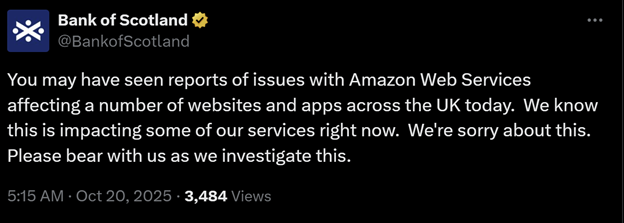
| The Price of CentralizationThe financial impact was big.Scratch that: huge.Let’s be honest—massive.Venmo halted transactions for hours. Robinhood trading froze mid-session. Netflix and Prime Video stalled during primetime in Asia. Even Britain’s National Rail booking system went offline.Meanwhile, Amazon’s own retail site sputtered. Alexa stopped answering. Smart homes went dumb. Coffee machines wouldn’t brew.A DNS bug in Virginia had turned into a virtual blackout for half the planet. |
 |
| Mehdi Daoudi, CEO of internet monitoring firm CatchPoint, said:“The financial impact of this outage will easily reach into the hundreds of billions due to loss in productivity for millions of workers who cannot do their job, plus business operations that are stopped or delayed—from airlines to factories.”See, here’s the problem…US-East-1, the epicenter of the outage, is Amazon’s oldest and busiest region, hosting orders of magnitude more workloads than any other. Even services running in Europe or Asia often depend on control planes or API gateways rooted in Virginia. When that region sneezes, the entire web catches pneumonia. And it’s not just Amazon.Between AWS, Microsoft Azure, and Google Cloud, three companies control more than two-thirds of global cloud infrastructure. Some people call them clouds. But they’re more like data continents. When one tectonic plate shifts, the shockwaves travel worldwide. The Cloud Is the Grid A decade ago, the cloud was important; today, it’s indispensable.Back then, downtime mostly stalled communication or content. Now, it disrupts the physical world—stopping payments, freezing AI systems, and halting production—because nearly every industry has migrated its core operations to the cloud. Meanwhile, the internet has evolved from a communications network into the backbone of global infrastructure, where even seconds of outage ripple through hospitals, supply chains, and financial systems alike.As more of the world’s physical systems—logistics, energy, vehicles, robotics—plug into the digital grid, the line between “online” and “offline” blurs entirely.And yet, the grid itself is still centralized. It doesn’t yet fully follow the internet’s logic of redundancy and decentralization, however much complexity has pushed the issue. Which brings us to the next phase of the internet’s evolution, of which we stand in the early beginnings. One that draws direct inspiration from Bitcoin’s very first lesson.But time is up. Even down under wasn’t immune to the outage. I got the following email from Xero As you are likely aware, Xero, like many other global companies, continues to experience slowness and login issues due the ongoing global outage by our third party provider, Amazon Web Services (AWS). We understand your access to Xero is important for your business. We are committed to updating you frequently via our Status page as new information becomes available. We are conscious of the impact when issues like this occur, and I thank you for your patience while we work with AWS to resolve this issue as a priority. Diya Jolly Xero, Chief Product & Technology Officer |

My xero wouldn’t load properly .
Oh dear, too bad, how sad, should never have moved everything to the “cloud”. Looks like reasons to not have smart home junk and carry cash with you
My standalone accounting package bought years ago remained operational as the computer is not internet connected, I have another one without vial business information stored internet connected and thats exactly were 99.99% of issue emerge from. I am seriously looking at having Linux Mint installed dual boot to exit microshite control and spying leaving my unconnected computer to continue driving machinery via WIN XP due to no driver updates.
If you put your data on someone else’s computer aka the Cloud, along with everyone else’s data, it becomes a huge target.
It was touted as the best thing since sliced bread. The usual marketing hype from Bit Tech, Big Pharma, etc. along with Climate change.
COP30 should be renamed CON30