


A Gigantic Wave in The Pacific Ocean Was The Most Extreme ‘Rogue Wave’ on Record
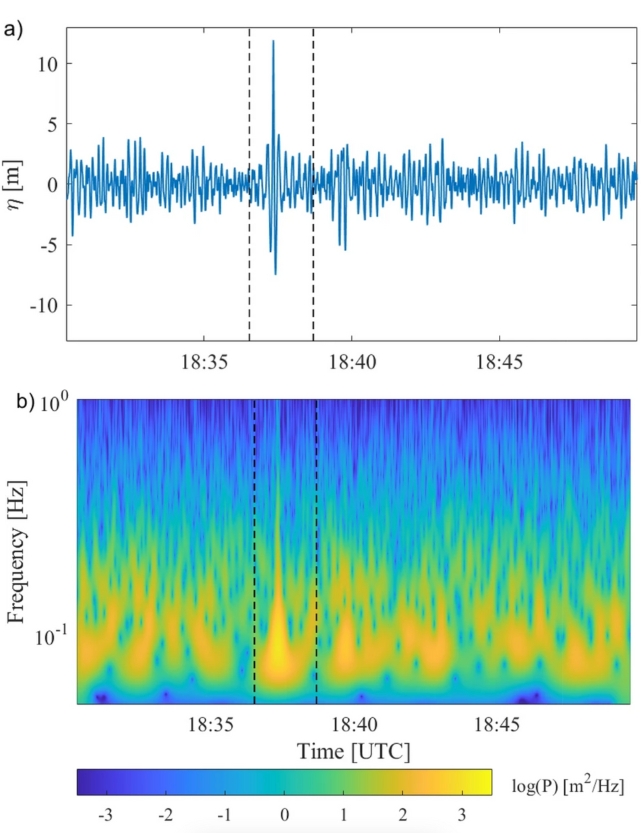
In November of 2020, a freak wave came out of the blue, lifting a lonesome buoy off the coast of British Columbia 17.6 meters high (58 feet).
The four-story wall of water was finally confirmed in February 2022 as the most extreme rogue wave ever recorded at the time.
Such an exceptional event is thought to occur only once every 1,300 years. And unless the buoy had been taken for a ride, we might never have known it even happened.
For centuries, rogue waves were considered nothing but nautical folklore. It wasn’t until 1995 that myth became fact. On the first day of the new year, a nearly 26-meter-high wave (85 feet) suddenly struck an oil-drilling platform roughly 160 kilometers (100 miles) off the coast of Norway.
At the time, the so-called Draupner wave defied all previous models scientists had put together.
Since then, dozens more rogue waves have been recorded (some even in lakes), and while the one that surfaced near Ucluelet, Vancouver Island was not the tallest, its relative size compared to the waves around it was unprecedented.
Scientists define a rogue wave as any wave more than twice the height of the waves surrounding it. The Draupner wave, for instance, was 25.6 meters tall, while its neighbors were only 12 meters tall.
In comparison, the Ucluelet wave was nearly three times the size of its peers.
“Proportionally, the Ucluelet wave is likely the most extreme rogue wave ever recorded,” explained physicist Johannes Gemmrich from the University of Victoria in 2022.
“Only a few rogue waves in high sea states have been observed directly, and nothing of this magnitude.”
Today, researchers are still trying to figure out how rogue waves are formed so we can better predict when they will arise. This includes measuring rogue waves in real time and also running models on the way they get whipped up by the wind.
The buoy that picked up the Ucluelet wave was placed offshore along with dozens of others by a research institute called MarineLabs in an attempt to learn more about hazards out in the deep.
Even when freak waves occur far offshore, they can still destroy marine operations, wind farms, or oil rigs. If they are big enough, they can even put the lives of beachgoers at risk.
Luckily, neither Ucluelet nor Draupner caused any severe damage or took any lives, but other rogue waves have.
Some ships that went missing in the 1970s, for instance, are now thought to have been sunk by sudden, looming waves. The leftover floating wreckage looks like the work of an immense white cap.
Unfortunately, a 2020 study predicted wave heights in the North Pacific are going to increase with climate change, which suggests the Ucluelet wave may not hold its record for as long as our current predictions suggest.
Experimental research published last year suggests these monstrous waves can be up to four times higher than previously thought possible.
“We are aiming to improve safety and decision-making for marine operations and coastal communities through widespread measurement of the world’s coastlines,” said MarineLabs CEO Scott Beatty.
“Capturing this once-in-a-millennium wave, right in our backyard, is a thrilling indicator of the power of coastal intelligence to transform marine safety.”

“Unfortunately, a 2020 study predicted wave heights in the North Pacific are going to increase with climate change, which suggests the Ucluelet wave may not hold its record for as long as our current predictions suggest”
Here is an 8 minute 16 seconds video exposing decades of Ridiculous Climate Change Predictions Failing Miserably: Perhaps if we add the above it can be 8 minutes and 20 seconds of failed predictions.
https://www.youtube.com/watch?v=Z0CXWOOd00k
Beat me to it… Fucking Climate Change, actually, waves do get bigger when the earth gets COLDER as the westerlies increase in strength during glacial periods, so warmer weather should equal less strong wind equals less rogue waves. Muppets.
This is a 30 m wave for perspective
https://x.com/thefigen_/status/1877004548591473098?s=12
I know nothing about surfing but a bit about balls. That guy must rent his out to shipping companies….
Imagine a twin hull maori canoe in that!
Weather modification technology can generate waves like that without missing a beat. Just as easy as it can create earthquakes and storms.
Unfortunately, a 2020 study predicted wave heights in the North Pacific are going to increase with climate change, which suggests the Ucluelet wave may not hold its record for as long as our current predictions suggest.
The four-story wall of water was finally confirmed in February 2022 as the most extreme rogue wave ever recorded at the time.
Bollocks. The Ucluelet wave is being milked for climate change. It is only called “rogue” when the source has not been identified.
“2011- Garret Macnamara rides a 78-foot wave at Nazare which at the time was credited by the Guinness Book of Records as the Worlds biggest wave.”
http://nzsurfmag.co.nz/the-story-behind-nzs-heaviest-wave/
The Ucluelet wave is a baby compared to other rogue waves.
On 11 March 1861 at midday the lighthouse on Eagle Island off the west coast of Ireland was struck by a large wave that smashed 23 panes, washing some of the lamps down the stairs, and broken glass damaged the reflectors beyond repair. In order to damage the uppermost portion of the lighthouse, water had to surmount a seaside cliff measuring 40 m (130 ft) in height and a further 26 m (85 ft) of lighthouse structure. 215 feet!
On 31 December 1914 at 4:40 p.m., United States Lighthouse Service Captain Fred Harrington, lighthouse keeper at Trinidad Head Light on Trinidad Head in Trinidad, California, saw a wave 200 yards (180 m) offshore approaching the bluff on which the lighthouse stood which washed completely over 93-foot-tall (28 m) Pilot Rock offshore, appeared to him to rise to the level of the lighthouse’s lantern 196 feet (60 m) above sea level, and then broke over the top of the 175-foot-tall (53 m) bluff on which the lighthouse stood. It was the largest recorded ocean wave ever to strike the United States West Coast, and Harrington’s report that that wave crested at the height of the lantern and that it buried the area between the lighthouse and the bluff in water which rose to the lighthouse’s balcony suggests a possible wave height of 200 feet (61 m). The wave’s impact shook the lighthouse and extinguished the light, although Harrington restored service in four hours.
read more…
https://en.wikipedia.org/wiki/List_of_rogue_waves
Not to mention the Tsunami in the Alaskan Earthquakes at 1720 feet.
The Ucluelet wave is being milked for climate change.