


The Huajiang Canyon Bridge is built 2,051 feet above the Beipan river.
By Andrew Paul
The world’s tallest bridge is set to open this summer—and its height is not for the faint of heart. Constructed in just three years for roughly $283 million, China’s Huajiang Canyon Bridge spans the Beipan river in southwestern Guizhou. In order to take advantage of reducing the once hour-long trip between mountains to a matter of minutes, drivers will need to be comfortable with traveling a roadway that’s 2,051 feet above a mountain gorge. That’s 275 taller than New York City’s One World Trade Center skyscraper.
While an undeniable feat of engineering, China is no stranger to vertigo-inducing suspension bridge projects. Prior to Huajiang Canyon Bridge’s completion, the country already had eight of the top ten tallest bridges in the world, as well as 43 of the top 50. The current record-holder—the 1,854-foot-tall Duge Bridge—is also located in China.
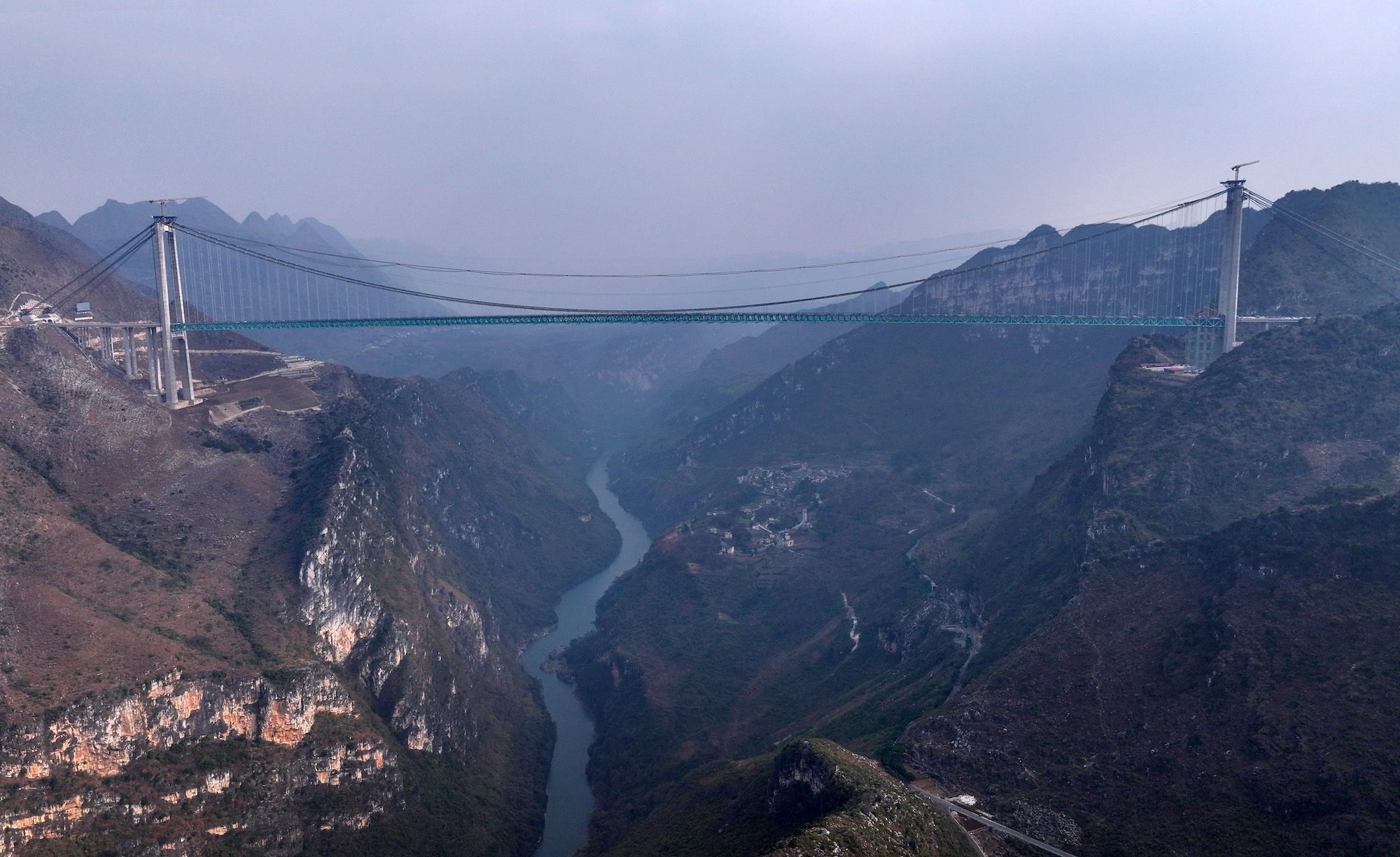
For this new bridge, engineers opted for a suspension bridge design given the difficult environmental conditions given Huajiang Canyon’s height. Suspension cables extending from two 860-foot-tall towers hang over the 4,660-foot main span over the river, and were specifically constructed to withstand the strong wind resistance typical at that altitude. The bridge’s main load-bearing steel truss structure includes 93 segments totalling about 22,000 tons, or around the same weight as two Eiffel Towers.
Speaking with Newsweek, University of Calgary professor of civil engineering Mamdouh El-Badry explained construction likely required “cable crane systems, modular deck sections, and high precision anchoring.”
Engineering factors went far beyond the project’s height. The extremely mountainous Guizhou region would have made transporting the construction materials a lengthy, difficult process, while the plateau’s atmospheric differences between daytime and evening are responsible for frequent high winds and adverse weather conditions.
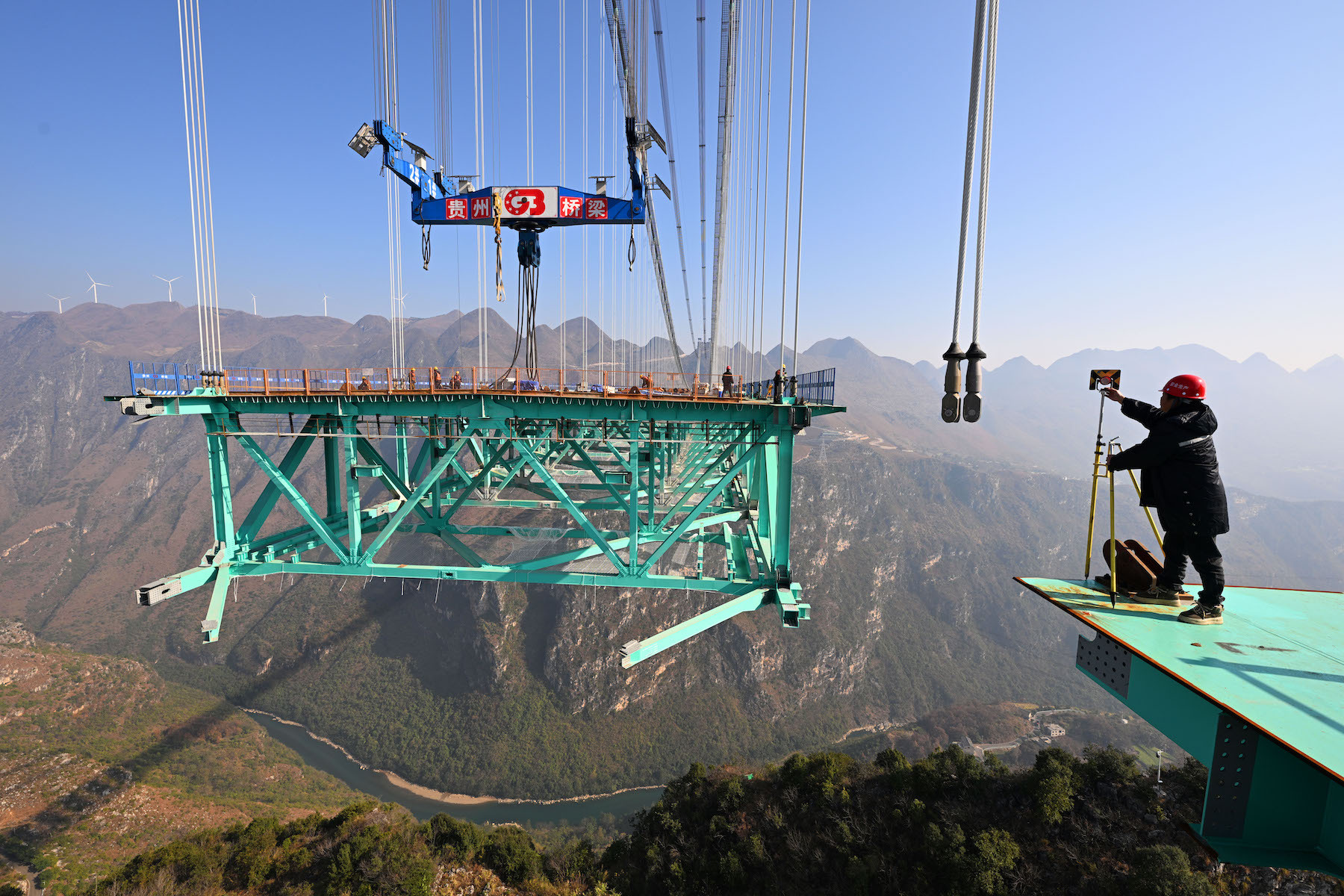
“Despite its scale, the bridge has a slim profile and sleek design, which reduces wind resistance and material use and minimizes visual disruption to the canyon environment,” added El-Badry.
Even with these challenges, China managed to complete Huajiang Canyon Bridge in only three years and ahead of schedule. In comparison, the Gordie Howe International Bridge that connects Detroit and Windsor, Ontario, will have taken over seven years to finish by the time it opens for traffic in Fall 2025. Unlike Huajiang Canyon, the Gordie Howe is only 722 feet tall.
However, there are understandable reasons for the lengthier construction time. Engineering projects in the United States are subject to numerous logistical, environmental, and political regulations. China’s centralized state-run government, meanwhile, isn’t beholden to the same oversight or concerns, allowing the country to fast-track endeavors like the Huajiang Canyon Bridge regardless of local pushback or ecological concerns.

Constructed in just three years for roughly $283 million,
meanwhile
the Auckland city rail link is 10 years in.
over SIX Billion dollars
for 3 km of choo choo
for choo choo dreamers
and still not open
but hey it will be nice
🤣💰💰💰
and out of action 50% of the time like the rest of AKL rail
Feel that Te Huia bro
This was Fast tracked (ha ha ) when johnny keys was PM
action …..by Step hen Joyce
Phool twitford would have poked his honker in there.
would you rather run in a tunnel built by people who know stuff or live in a Chinese-built apartment block when an earthquake comes along? ( like just recently and like the Auckland car park that failed because of their steel.
Meanwhile here is the latest train test from the tunnel.
yep its on FB where all the good news is.
https://www.facebook.com/cityraillink
Don’t bother complaining like school girls fighting over boyfriends. Its a bit boring from boring people..
Mr Coot
RU suggesting that a tunnel that is 3 km long and unfinished after ten years, with all the technology available, is being
built by people who know stuff
fuck off
so a 30 km tunnel to the airport – all BS of course
would take over 100 years.
and
Dont give me that US Deep state spyware fakebook shit, either.
You really are demented, aren’t you. When a video that’s made in Auckland about Auckland triggers your CIA button you need a physiatrist badly.
and I see you did just what I thought you would. raved like mooning school girl.
“…failed because of their steel.”
I sincerely doubt that “their steel” was used in this bridge.
And we should be not saying that all “Chinese steel” is the same, any more than all NZ products, scientists, and medical experts are the same.
Sean Hendy does not measure up to Ernest Rutherford. Both scientists.
And Michael Baker, and Sir Ashley Bloomfield do not measure up to Fred Hollows and Sir Brian Barratt-Boyes. All medical experts.
Sir Brian Barratt-Boyes would roll over in his grave at what Baker and Bloomfield have done over heart injuries, injuries in general, and deaths, caused by the mRNA non-vaccines they pushed, and are still pushing.
Many good things come out of China as well as many bad things, just like NZ.
And as we know, and confirmed by the deaths in two or more specific buildings in the Christchurch earthquakes, it is not just the products used, but how they were used, and more importantly who tested and selected the materials and/or designs used.
A bad workman always blames his tools and materials, but he/she was the one that chose them.
https://www.facebook.com/reel/694040503189350
There’s a good reason why Trump is kicking shit out of China.
thieves in everyday. Pirates in everyway and always have been.
the building did what they were supposed to do. Keep people safe in an earthquake. The issue is and remains why were people allowed back into that building when it was heard groaning and moaning days later.
The persons that allowed that were the ones who need to answer why they bowed to the building owners and gave the ok for people to return.
Ask questions around that.
Being a devout coward, that’s a nope from me, but I do note the lack of orange cones. Are they all being used in New Zealand – can we not spare the Chinese a few?
The man on the edge is obviously a dispensable crew member, no tethering and condensation on the bridge surface would make for a very long drawn out scream if he slipped.
https://nzhistory.govt.nz/media/photo/makatote-viaduct
Christchurch firm J. & A. Anderson won the Makatote construction tender in 1905. The site was forbidding, 792 m above sea level amid thickly forested hills. Storms, floods and shortages of cement and skilled labour made things worse.
Anderson set up a fully equipped workshop and brought in 1238 tonnes of cement and 1016 tonnes of steel by wagon from the railhead.
Using a cableway stretched across the gorge between timber gantries, they had the viaduct ready by July 1908.
Soon trains began rolling uninterrupted between Auckland and Wellington, transforming travel in the North Island and turning the government railway into a modern main-line system. Passenger numbers soared from 3.5 million in 1895 to 13.3 million in 1913 and freight carried rose from 2 million tonnes in 1895 to almost 3.9 million tonnes in 1913.
The Makatote Viaduct is not our longest railway viaduct, but still offers some impressive statistics:
it is 262 m long and 79 m high.
There are six concrete and five steel piers.
Twenty-three major viaducts and 26 bridges made the North Island main trunk an impressive project by any standards.
When the American Society of Civil Engineers awarded the line its 27th International Historic Civil Engineering Landmark Award in 1997, it joined the Statue of Liberty, the Eiffel Tower and the Panama Canal on a very select list. Just south of the viaduct, the Last Spike Monument marks the spot where Sir Joseph Ward drove the final spike into the line on 6 November 1908.
———–
AFAIR no deaths on this
they used rope around the waist of the workers
a bleak place to work
Full credit to the workers.
3 years to build
whereas 10 years on CRL and not finished, all that technology and just useless
The 3000 km Trans pac railroad in USA was built in 6 years,
over Sierra Nevada mountains, bridges and tunnels
6 years finished
3 during civil war.
rail line was being pulled up at night by the native americans
No 0800 fkg redskins
dob-in line then
NZ productividy is so close to ZERO no discernible productividy can be found
but hey we will spend $13 mil to bring in tourists
oh yay
they can tour orange comes
and call the 0-800 number if they see too many .
Nicki Willyless- build back bedder
three decades would pass before engineers and politicians could overcome the opposition of King Country Māori
So nothing new then? Todays Maori are holding the country to ransom, demanding everything they can get. What we need is a govt that tells them it’s time to fuck off and abolish the WT. Since it’s decisions are not binding, why do successive govts continue to do that?
15.5 seconds from ‘oh fuck’ to ‘splat’. Should give enough time to cover a few octaves! 🙂
we could gift china some iwi, a treaty and half of our politicians.
that will bankrupt, delay and destroy the place better then any of trumps tariffs