

Trump Racks Up $3 Trillion of Investments in US Economy
Bradley Devlin
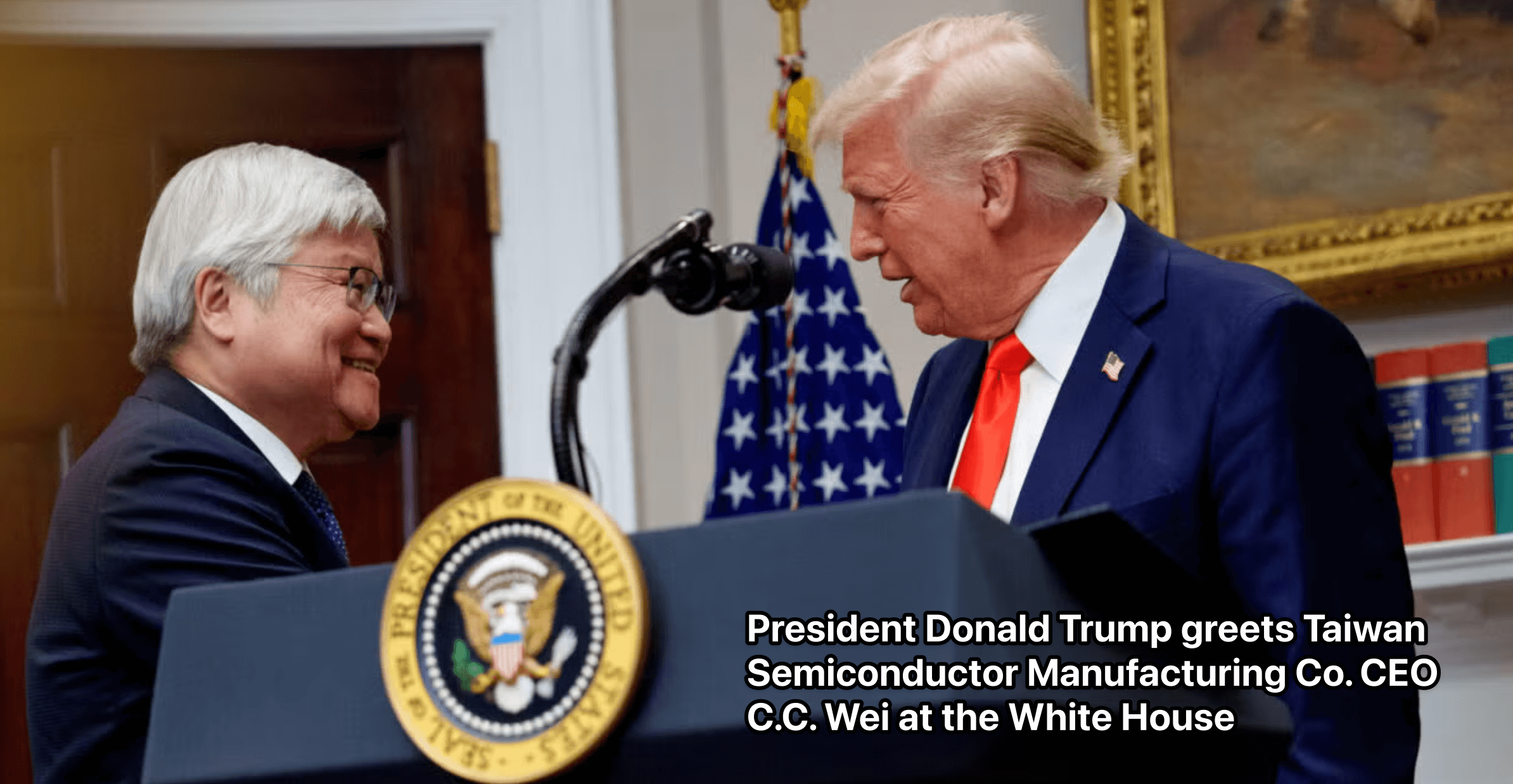
For President Donald Trump, the Taiwan Semiconductor Manufacturing Co.’s $100 billion investment in U.S. chip manufacturing represented “a tremendous leap—like, a leap that nobody would have really said was possible.”
But TSMC’s $100 billion is just a small part of the at least $3 trillion in investments and trade commitments the Trump administration has racked up in just six weeks since Inauguration Day.
The $3 trillion of investment and trade commitments with the United States involve key allies, such as India and Japan, and major players in the private sector—Apple and Oracle, to name just two. These arrangements also cover critical industries beyond chip manufacturing, from pharmaceuticals to automobiles to artificial intelligence.
With the announcement of TSMC’s $100 billion investment—which Trump celebrated with TSMC CEO C.C. Wei, Commerce Secretary Howard Lutnick, and AI czar David Sacks on Monday—the Taiwanese company is nearly tripling its previous investment in additional chip manufacturing investment in the United States.
Before the announcement, TSMC had invested $65 billion in U.S.-based manufacturing. Its first American manufacturing plant in Arizona, which began with a $12 billion investment in 2020, opened for business late last year.
TSMC plans to use the $100 billion in new investment to set up three new chipmaking plants, two chip-packing plants, as well as a research and development center.
TSMC dominates the global semiconductor industry. In terms of revenue, its foundries account for more than 60% of global market share. But that was not always the case. Just over 30 years ago, the U.S. accounted for 37% of global semiconductor production, while Taiwan was just a few measly percent.
U.S. policymakers engrossed in the doctrines of free trade saw the semiconductor industry flee to subsidized and protected Asian markets. For decades, free-trade dogmatism dragged America into a ditch.
Now, the Trump administration is offering a way out. Trump’s policies have spurred investments that diminish China’s leverage over the American economy. These investments are a foundational pillar for any attempt to make the U.S. economy more resilient to a China shock and revitalize American manufacturing.
During his first full day of his second term, Trump unveiled “Stargate,” a $500 billion investment into artificial intelligence over the next four years. Trump called Stargate—a collaboration between SoftBank, OpenAI, and Oracle—“the largest AI infrastructure project, by far, in history.”
Just a month prior, SoftBank announced a $100 billion investment that aimed to create 100,000 American jobs. Additionally, Trump secured a $20 billion initial investment by DAMAC Properties in early January for new data centers based in the U.S.
As Vice President JD Vance outlined in his speech at the Paris AI summit last month, the Trump administration is committed to competing with China in the AI space while also challenging European notions of how to regulate AI and chart the future of the AI economy.
After Trump said his administration was considering placing tariffs on pharmaceutical imports, the pharmaceutical company Eli Lilly announced it planned to invest $27 billion in four new manufacturing facilities in America. The company claimed that, once complete, the plants will create more than 3,000 jobs. Building the facilities themselves will require 10,000 construction workers, the company added.
Since China’s accession to the World Trade Organization, production of generic drugs and the chemical compounds used as inputs for those drugs increased at a rapid pace. That was not the “invisible hand” at work; rather, it was the result of conscious policy choices on the part of the Chinese Communist Party to subsidize those industries, thereby undercutting drug producers and jobs in the U.S. and across the West, nations that were at the time drinking deeply from free-trade dogmatism.
Tariffs also may have been a factor in Apple’s decision to invest in the American economy. After Trump announced an additional 10% tariff on China, Apple announced it would be investing $500 billion in the United States and hire approximately 20,000 workers. Apple plans to open a new factory in Texas and a manufacturing academy in Detroit, as well as expansions in Arizona, Nevada, California, North Carolina, and other states.
Apple will double its investment in its U.S. Advanced Manufacturing Fund, which includes working alongside TSMC in the Taiwanese company’s Arizona facility to produce advanced silicon.
Apple plans to hire the 20,000 workers over the next four years, the vast majority of whom will be focused on silicon engineering, AI and machine learning, and the like.
Trump has also worked with foreign leaders to court more investment in the American economy and bolster American exports. Saudi Arabian Crown Prince Mohammed bin Salman pledged the kingdom would invest $600 billion in America. Indian Prime Minister Narendra Modi agreed with Trump on increasing the trade between U.S. and India to $500 billion.
Japan, meanwhile, has promised to open more auto plants in the U.S. and import American liquified natural gas at “historic” levels, thereby reducing America’s trade deficit with its Asian ally. One Japanese automaker, Honda, is reportedly moving production of the Honda Civic hybrid from Mexico to Indiana in response to Trump’s tariffs on Mexico and Canada.
For Trump and his administration, “Make America Great Again” starts with actually making things in America again.

Not for a moment belittling Trump’s initiatives but ‘the Taiwan Semiconductor Manufacturing Co.’s $100 billion investment in U.S. chip manufacturing represented “a tremendous leap—like, a leap that nobody would have really said was possible.” ‘ could have much to do with America’s new isolationist policies.
Sooner or later China will move on Taiwan. The downturn they will experience by no longer manufacturing tat for the Yank markets will send them looking for something to distract the unemployed & invading Taiwan would fit the bill.
Taiwan manufactures most of the world’s chips. The owners of the chip making companies would rather move to the States than face reprogramming in a PRC gulag. It’s a win/win position for all involved.
I agree and in doing this Taiwan is less valuable to China and in a invasion scenario the chip plants would be demolished assuming China doesn’ get a bloody nose trying to land on the beach – check out the Geography of Taiwan and the confitions in the strait – I suspect an attampt by China would see large number of Chinas ships and sailors join Davy Jones and when the word gets back some/many chinese sailors may disappear.